
The Method: What You Lost, and Why Your Waistline Changed
Both sexes lose it, but not by the same route.

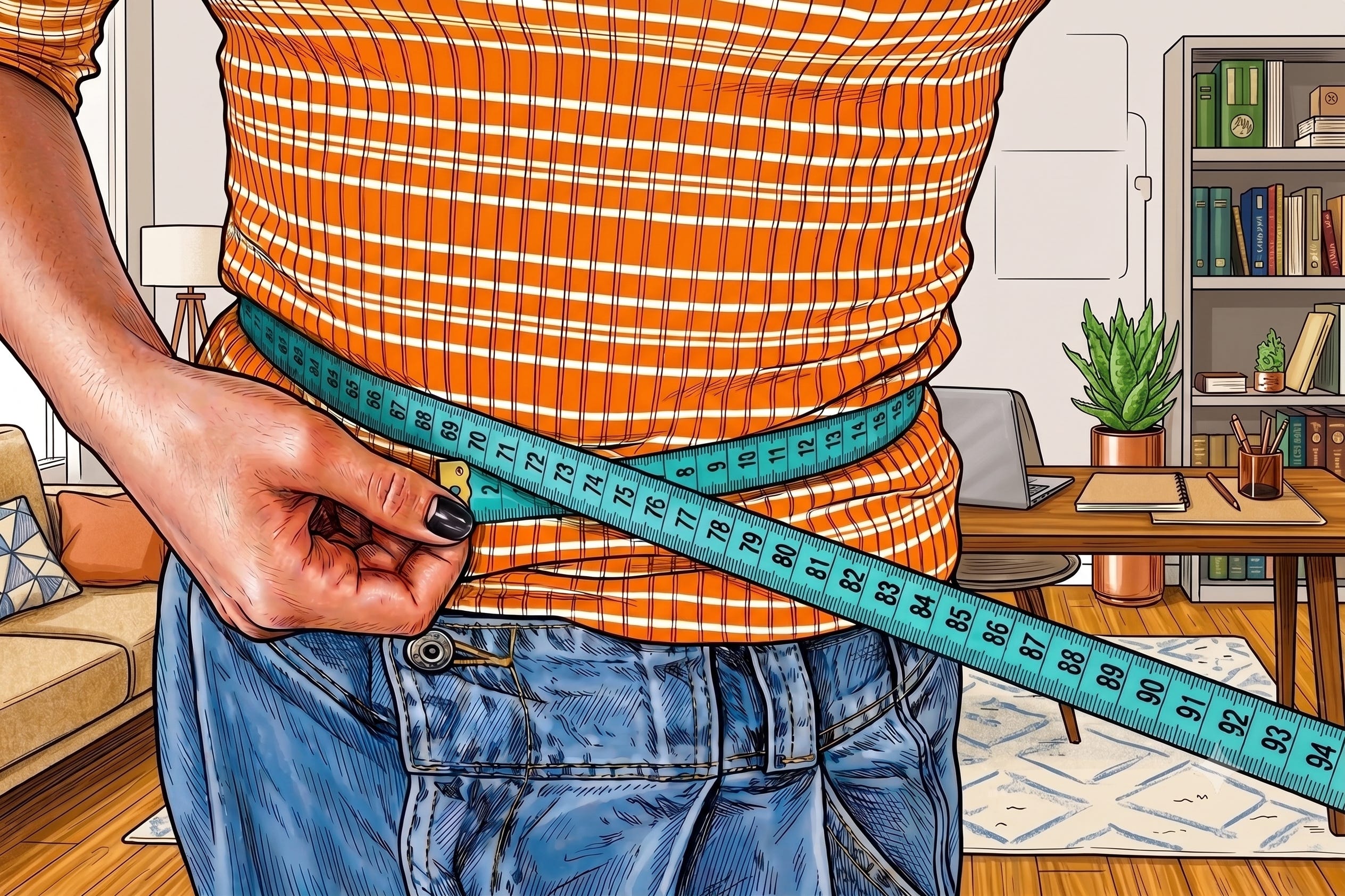
A husband and wife in their fifties came to see me. Both had noticed their waistline increase over the past few years. They had not changed their diet. It had always been home-cooked meals.
She had been told it was the menopause. He had been told it was his age.
Two different explanations, for a similar change. Neither offered any guidance on what could be done about it.
When your waistline changes, you almost certainly ask: What have I started doing that caused this?
It made no sense
To understand what may be behind this change, it helps to look at a rare case that stripped the question down to bone.
A 29-year-old man arrived at a clinic carrying weight around his middle that did not match a body that age1. His waist was thick. A scan showed his liver was marbled with fat. His blood sugar had already developed into type 2 diabetes. The skin under both arms had darkened into velvety patches, a change that appears when insulin has been running high in the blood for a long time.
None of it fit. He was not a heavy eater. And when a man carries fat around the middle like this, the hormone we tend to think about first is testosterone, because a shortage of it is a known cause of exactly this pattern in men. So they measured his. It was normal, if anything, high.
They tried testosterone treatment regardless. His metabolic markers got worse. The insulin resistance increased, the diabetes remained the same.
Then they tried a hormone nobody expects to give a young man. They gave him oestrogen.
His insulin resistance improved. The fat in his liver receded. His blood sugar dropped. Two plaques that had formed in his carotid arteries disappeared.
Genetic testing showed that his body could not produce oestrogen. A mutation in a single gene had knocked out aromatase, the enzyme that turns testosterone into oestradiol. So despite all that testosterone, he had almost no oestrogen in circulation.
The fat around his middle, the fat in his liver, and his high insulin had all been kept in check, in a man, by oestrogen, the hormone most people think of as a female hormone.
His condition is extremely rare. But it shed light on something that applies to everyone, including the couple in my consulting room.
Fat deposition and insulin sensitivity are not just results of how a person lives, though we tend to reduce them to that. They are actively controlled by hormones, and where that control is absent, for whatever reason, the waist is prone to expand.
A change the scale cannot reflect
Now back to the wife, and to one useful piece of research in this field.
Greendale and colleagues2 , followed 1,246 women through the menopause transition, scanning them repeatedly with DXA, a body scan that measures fat, muscle and bone. The scans showed something interesting. The rate of fat gain doubled, from 0.25 kg a year before the menopause transition to 0.45 kg a year during it.
So, at the same time, the woman’s muscle mass reversed direction, from a slight yearly gain into a yearly loss. Fat was being added and muscle taken away at the same time.
All of this happened inside a specific window: roughly two years before her final period through to about eighteen months after it.
Her body composition shifted over about three and a half years.
Her brake: oestradiol
Oestradiol restrains fat accumulation and influences where fat is deposited. During the transition her oestradiol drops sharply. Her androgens, the male-type hormones women also make in smaller amounts, fall far less, so the balance between the two tips toward the androgens. A lower oestrogen-to-androgen balance is associated with more visceral fat, the deep fat around the organs, and less of the subcutaneous fat that used to be stored in hips and thighs3.
Her fat did not just increase. It relocated to the abdomen. And the abdomen is a key site that drives insulin resistance.
His brake: testosterone
Testosterone provides similar protection in a man, and he loses it too. Men do not have a menopause, but their testosterone declines gradually, from around the age of 40, and faster if weight is gained4 . The decline is easy to miss, which is part of why the waist is often the first thing he notices.
Testosterone prevents fat storage through two routes at once.
The first route is direct. Fat cells begin as unspecialised cells that later mature into fat-storing ones. Testosterone, and its stronger relative dihydrotestosterone (DHT), interrupt that process: they stop those young cells from becoming mature fat-storing cells in the first place5 . These hormones act through receptors on fat cells. Those receptors are more common in deep abdominal fat than in the fat just under the skin, so testosterone may have its strongest effect where visceral fat tends to build.
The second route runs through oestradiol. A man makes his oestradiol from his own testosterone, and he needs it: in men, oestradiol helps hold body fat down and supports bone strength and libido.
In a study of 400 men6 whose own hormone production was suppressed and then replaced at graded doses, how much body fat a man gained depended on his oestradiol level; while his muscle mass, thigh size and leg strength depended on his testosterone. When the body was prevented from turning testosterone into oestradiol, the men gained more body fat at every testosterone dose. This showed that oestradiol helps limit fat gain in men, independently of testosterone.
The young man in the published clinical case, had lost only one of these two routes: the oestrogen one. A midlife man losing testosterone loses both at once: the direct brake testosterone puts on fat cells, and the oestradiol his body would have made from it.
Low testosterone and visceral fat can reinforce each other. The testes may produce less testosterone with age, while excess weight may disrupt the brain signals that tell the testes to make testosterone. In a study of 3,369 men7, carrying excess weight was linked to about three times the risk of developing this second form.
Fat tissue contains aromatase, an enzyme that converts testosterone into oestradiol. As abdominal fat increases, this conversion may increase and, in some men, stronger oestradiol signalling may further suppress testosterone production. This can create a cycle: more abdominal fat may lower testosterone, while lower testosterone may make further fat gain easier by reducing muscle mass and weakening the restraint on fat storage.
Oestradiol’s role in men can therefore seem contradictory. At normal levels, it helps limit fat gain. But when excess abdominal fat alters the balance between oestradiol and testosterone, the overall effect may work against him.
The practical solution is clear. In a review of 24 studies, a low-calorie diet raised total testosterone, and weight-loss surgery raised it about three times as much8 .
In both the man and the woman, declining sex-hormone activity may have weakened those main controls of abdominal fat accumulation. Hers was oestradiol affected by menopause. His was testosterone.
His hormone problem may be corrected by reducing abdominal fat. Hers cannot. But she can still act on what the lower oestradiol is doing to her muscle and her insulin sensitivity.
Other forces affect these changes too: thyroid disease, and some common medications, such as corticosteroids like prednisolone and certain antidepressants, which alter body fat and metabolism on their own.
Sleep loses hormonal support too
In the cortisol article, I described early-hours waking as a potential nocturnal glucose dip pulling up cortisol and adrenaline, and said the hormonal half of that story had its own article ahead. This is it.
For her, the broken night is a combination of two factors.
Falling asleep is very much a progesterone story in women. The body converts progesterone into a calming compound that acts on the brain’s main quietening system (the GABA-A receptor), the same system sedative medicines work on. As progesterone declines during menopause, that sedative support is gone9 .
Waking too early in the morning is an oestradiol story for women. Oestradiol helps regulate body temperature, partly by widening the small blood vessels near the skin so the body can release heat. As it falls, night sweats and hot flushes produce repeated arousals; and rising follicle-stimulating hormone (FSH) with falling oestradiol is associated with more time awake after sleep onset and more fragmented sleep. The cortisol pattern then adds one more layer to the problem.
For him, the loop runs in the opposite direction where sleep quality affects testosterone levels. Factors including obesity, sleep apnoea and stress may affect sleep. Leproult and Van Cauter10 restricted ten healthy young men to five hours in bed for eight nights. Their daytime testosterone fell by 10 to 15 per cent. Testosterone may decline naturally at roughly 1 to 2 per cent a year, so the effects of one week of short sleep can be compared to those of a decade of ageing.
His broken night works both ways. It can increase appetite and worsen insulin sensitivity, making fat gain more likely. That extra fat may then contribute to lower testosterone, while lower testosterone can further weaken the body’s restraint on fat storage.
Finding your cluster
These clusters can help you identify patterns, but they cannot diagnose a condition. The symptoms overlap, and persistent or significant changes may require clinical assessment and appropriate testing.
The sex-hormone cluster:
For a woman: if the abdominal weight developed together with hot flushes, night sweats and cycle changes, and appeared over a defined few years, the sex-hormone cluster may be driving it.
For a man: if abdominal weight gain developed together with a reduction in libido, over a defined period, the sex-hormone cluster is the place to look.
The cortisol cluster:
If instead the weight followed early-hours waking, stressful days, or prolonged life life pressure, look at the cortisol cluster first.
The blood-sugar cluster:
If the abdominal weight occurred with post-meal energy dips, rising fasting glucose or triglycerides, and cravings that build through the afternoon, the blood sugar imbalance is the place to start.
Note that most people have more than one cluster running. The question you need to answer is which ones may be predominant right now.
Get ready to act on what has changed, with clear steps below for both women and men. You also get access to the clustering guide, which helps you work out which pattern is yours and what to do about it, using your own results.
