
The 4 Things That Change When You Eat Too Little. Not One of Them Helps.
There is a reason your efforts stopped paying off.

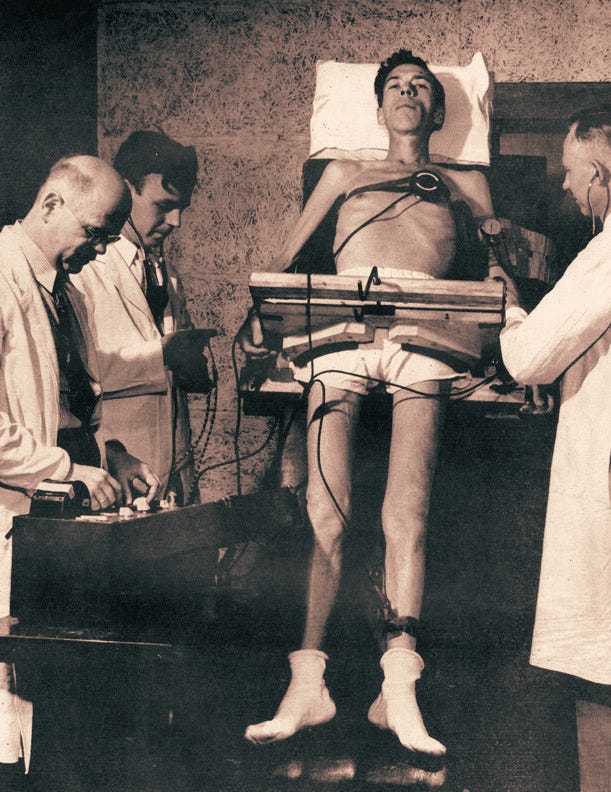
Life magazine photograph of conscientious objector being examined on a tilting table during starvation experiment. July 30,1945. Volume 19, Number 5, p. 45. Credit: Wallace Kirkland/Time Life Pictures/Getty Images (Kalm and Semba, 2005).
In November 1944, in a laboratory built into the vaults beneath the football stadium at the University of Minnesota, thirty-six young men were fed meals containing about half the food their bodies needed.
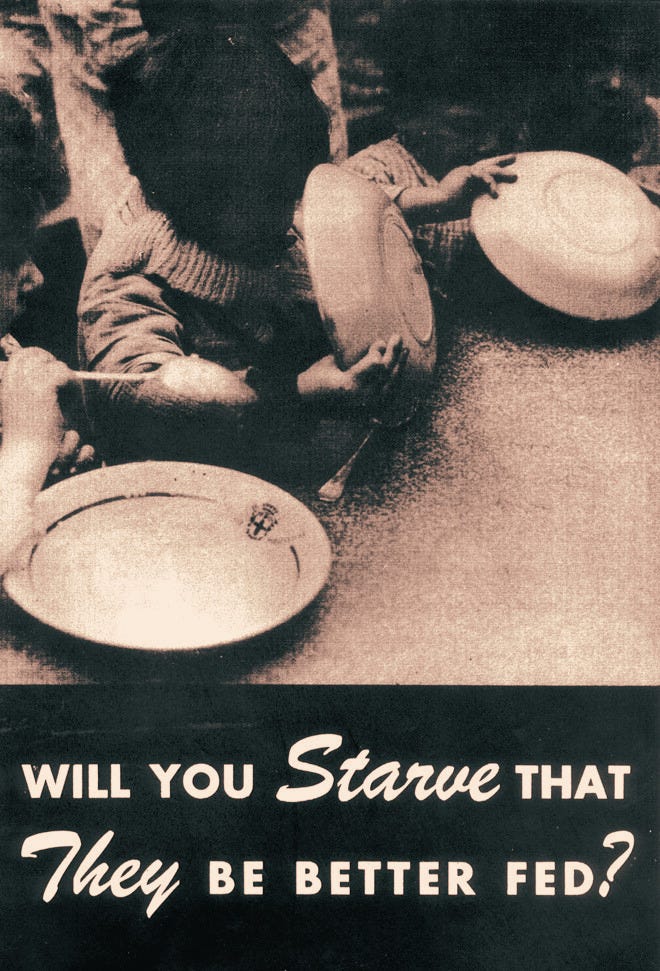
They had volunteered for it. During the war a recruitment brochure had circulated among conscientious objectors. Its cover showed three hollow-cheeked children staring down into empty bowls, and above there was this question: Will you starve (so) that they be better fed? More than four hundred men said yes. Thirty-six were chosen, the fittest and healthiest of the applicants, they were examined and declared medically fit.
For the next six months the men lived on turnips, swede (rutabaga in the United States), macaroni, and dark bread. And their bodies began to change in ways the researchers had not entirely foreseen.
They grew gaunt. They felt cold in a heated room. They turned listless and irritable and could not hold a thought for long. Above all they became consumed by thoughts of food, reading cookbooks for hours, hoarding recipes they had no means to cook, drawing out every mouthful of food they were given. Their heartbeats became slower. Their resting metabolism fell by around 40%1. This means that their bodies started using about 40 per cent less energy while at rest.
That was the physiological response of their bodies to the energy deficit.
Nobody today is living on swede in a basement laboratory. But a similar version of the same mechanism runs in anyone who has eaten too little for too long. The body adapts to preserve energy.
Those men showed that these adaptations can result from the calorie deficit, not from any particular age or health state. However, as we age, the consequences of these adaptations are heavier and harder to reverse. There is less muscle in midlife, and rebuilding it requires more effort. The resting metabolic rate (=the energy your body uses while at rest) is already lower than it used to be. Oestrogen in women and testosterone in men are falling during this phase of life, and these hormone changes accelerate the loss of muscle. So, the challenge of under-eating can lead to greater muscle loss than it would at a younger age, as well as a lower resting metabolic rate.
You might be counting on the same arithmetic yourself. Eat less, weigh less.
You have reduced the bread. Minimised the portions. Maybe you skipped breakfast. The plates became smaller and the hunger louder, and still the weight would not come off. The scales settled at a number and stayed there. The same waistband, still tight.
Months, even years of eating less, and the weight will not move. So you ask:
I am barely eating anything. What is there left to cut?
The Assumption Underneath the Advice
It is a reasonable question. Very logical: If you are overweight, eat less. If eating less has not worked, you are still eating too much, so reduce it further. Cutting further feels like the only lever left.
But for anyone in midlife, woman or man, who has been under-eating for years, eating less is frequently the reason the numbers hold where they are.
A long energy deficit sets four adjustments running. Each one is the body responding sensibly to less fuel. Together they work against the exact result you have been chasing, and beyond a certain point, individual metabolic and hormonal adaptations drive much of the difference between who loses and who does not2.
The First Thing to Go Is Heat
When energy coming in stays low for long enough, the amount you burn at rest comes down. Researchers call it adaptive thermogenesis, and it is measurable within the first week of eating substantially less. In one controlled study, resting energy expenditure dropped by roughly 100 calories a day after only seven days of heavy restriction, and those whose metabolism dropped the most lost the least weight in the end3.
This lower expenditure is normal physiology. When the body is given less fuel, it spends less. The reduced rate can also outlast the diet. The longer the deficit has run, the longer the reduced rate tends to be maintained. In some people it stays low even after normal eating returns4.
And then there is the second factor.
The Second Is the Hormone That Sets the Pace
The thyroid sets the pace of your metabolism, meaning how fast your cells turn fuel into energy, how much heat your body produces, and how hard your heart works at rest. It does this largely through T3, the active form of thyroid hormone. Most T3 is not produced by the thyroid directly. It is converted from the storage form, T4, out in the tissues. Prolonged energy restriction reduces that conversion.
In one study, twelve months of modest weight loss lowered circulating T3 significantly while the standard thyroid tests, TSH and free T4, barely changed5. This is what most blood panels miss. A doctor reading a normal TSH may reasonably conclude the thyroid is fine, while the active hormone that sets the metabolic pace has come down. Lower T3 means a lower resting rate, more sensitivity to cold, flatter energy, and a system running at reduced output.
The Third Is a Stress Response
Running on very little food is itself a physiological stressor, and the body responds to stressors through cortisol.
Significant restriction and prolonged fasting raise cortisol. A meta-analysis of thirteen studies found the effect strong for fasting, and weaker or absent for gentler calorie reduction6. But cortisol can climb even with everyday dieting. In one controlled study, people who counted and cut their daily calories showed higher cortisol and reported feeling more stressed7.
Higher cortisol pushes glucose up through the liver and works against insulin. So, paradoxically, the more you cut back, chasing a weight that will not shift, the higher your fasting blood sugar may rise.
The Fourth Is the Tissue You Most Need to Keep
When protein and total energy both stay low, the body draws on muscle for fuel. Muscle is expensive to keep and easy to release, and in a deficit without enough protein, or enough demand to keep it, it goes.
That loss carries a metabolic cost far beyond strength. Skeletal muscle is the largest site of glucose disposal in the body8. It clears sugar from the blood, including through routes that do not depend on insulin. By losing muscle you lose the tissue that keeps your cells insulin-sensitive.
The encouraging part is how modifiable this one is. In a controlled trial, people in an energy deficit who ate substantially more protein and trained against resistance gained lean mass and lost fat at the same time9. The calorie deficit did not have to cost them muscle. What they ate, and how they moved, determined whether it did.
Four Changes, All Pointing the Same Way
Take the four effects of calorie restriction together: lower resting rate, lower T3, higher cortisol, less muscle. Each one predisposes the body towards preserving energy rather than releasing it, and towards higher blood sugar rather than lower.
These were the same changes that overtook the men in Minnesota: the collapse in resting metabolism, the cold that persisted - signs of thyroid hormone metabolism changes, the muscle wasting from their frames. In them, it was severe and clear to see. In a mild, sustained deficit the same adaptations happen but are subtle and may remain hidden, which is what makes them so easy to miss.
You might reasonably ask why those men lost weight, when the argument here is that eating too little holds the weight in place. They did lose weight, plenty of it. But to keep it coming off, they had to keep cutting back. As their metabolism fell, the same rations stopped producing the same loss, and the researchers had to keep reducing their food10.
That falling metabolism is the adaptation. Six months in, the Minnesota men were still in its early phase, still losing. Someone who has spent years under-eating has been in that state long enough for the body’s adaptation to settle in. Intake and output are even, and the weight stops changing.
So your food diary looks as though it should guarantee weight loss, while the scale remains stubborn and the blood markers may not improve.
The effort is heroic. The food intake really is minimal. The return on that effort has been turned against itself by a system defending its reserves.
In midlife there is often a further hormonal layer, and it runs differently for women and men. If you are a woman, falling oestrogen accelerates muscle loss and changes where fat is stored11. If you are a man, declining testosterone does much the same, by a different route.
Either way it compounds every one of the four changes above. In this respect, women and men are more alike than they are different. Genetics, years of metabolic strain, hormonal changes, medication, thyroid imbalances: all of these affect the numbers together with anything you eat or do.
What Eating Enough Actually Does
Eating enough, and eating enough protein in particular, reduces the pressure to break down muscle for fuel, supports the conversion of T4 into active T3, and lowers the stress load that keeps cortisol raised. This is central in protecting the metabolic rate.
Protein at each meal gives the body less reason to take from muscle. Enough total energy intake reduces the need to conserve. Resistance work then gives muscle a reason to stay. Together, these three move the four adverse effects of under-eating in the opposite direction.
You do not have to have been diagnosed with anything, for the same four changes to be happening to you. They take hold of anyone who eats too little. So if your blood test results still read normal, and you assume that eating less is always the safer choice, you are counting on the same flawed arithmetic.
So here is the permission: you are allowed to stop eating less.
It is natural to fear that eating more can only mean gaining weight. But if a long deficit is what has kept the weight from moving, recovery has to start differently: with enough food, enough protein, and resistance work introduced together. These are the conditions that allow your resting metabolic rate to rise again, protect the muscle that helps clear glucose, and bring cortisol and insulin down.
Go gradually. If you have been eating very little for a long time, a sudden jump to large meals can land as fat gain, because your metabolic rate is reduced to meet your low intake. Add food back in small steps over a few weeks, and start resistance work at the same time, so the extra energy goes into rebuilding muscle rather than into storage.
Expect the scale to rise a little at first, since much of that early weight is water and refilled muscle glycogen, not fat. Judge the change over months, by how your clothes fit, your strength, and your energy, rather than by the number each morning.
Together these are the conditions in which the body can release fat instead of holding on to it.
The hunger you have been overriding was accurate all this time. You were actually short of fuel. Eating enough is the work itself, the thing that will allow the weight to move.
The Reverse
The guidance here is the reverse of the one you have been following for years, and, I know, it asks something even more challenging than restraint. It asks you to trust that feeding yourself is the intervention. I get how this is tough to accept.
If eating less and less has taken you nowhere, the smartest question is not how much more to take away.
The focus should be on what has been missing that made weight loss almost impossible.
Kalm LM, Semba RD. They starved so that others be better fed: remembering Ancel Keys and the Minnesota experiment. J Nutr. 2005 Jun;135(6):1347-52. doi: 10.1093/jn/135.6.1347. PMID: 15930436.
Theodorakis N, Kreouzi M, Pappas A, Nikolaou M. Beyond Calories: Individual Metabolic and Hormonal Adaptations Driving Variability in Weight Management-A State-of-the-Art Narrative Review. Int J Mol Sci. 2024 Dec 15;25(24):13438. doi: 10.3390/ijms252413438. PMID: 39769203; PMCID: PMC11676201.
Heinitz S, Hollstein T, Ando T, Walter M, Basolo A, Krakoff J, Votruba SB, Piaggi P. Early adaptive thermogenesis is a determinant of weight loss after six weeks of caloric restriction in overweight subjects. Metabolism. 2020 Sep;110:154303. doi: 10.1016/j.metabol.2020.154303. Epub 2020 Jun 27. PMID: 32599082; PMCID: PMC7484122.
Fothergill E, Guo J, Howard L, Kerns JC, Knuth ND, Brychta R, Chen KY, Skarulis MC, Walter M, Walter PJ, Hall KD. Persistent metabolic adaptation 6 years after "The Biggest Loser" competition. Obesity (Silver Spring). 2016 Aug;24(8):1612-9. doi: 10.1002/oby.21538. Epub 2016 May 2. PMID: 27136388; PMCID: PMC4989512.
Agnihothri RV, Courville AB, Linderman JD, Smith S, Brychta R, Remaley A, Chen KY, Simchowitz L, Celi FS. Moderate weight loss is sufficient to affect thyroid hormone homeostasis and inhibit its peripheral conversion. Thyroid. 2014 Jan;24(1):19-26. doi: 10.1089/thy.2013.0055. PMID: 23902316; PMCID: PMC3887425.
Nakamura Y, Walker BR, Ikuta T. Systematic review and meta-analysis reveals acutely elevated plasma cortisol following fasting but not less severe calorie restriction. Stress. 2016;19(2):151-7. doi: 10.3109/10253890.2015.1121984. Epub 2016 Jan 7. PMID: 26586092.
Tomiyama AJ, Mann T, Vinas D, Hunger JM, Dejager J, Taylor SE. Low calorie dieting increases cortisol. Psychosom Med. 2010 May;72(4):357-64. doi: 10.1097/PSY.0b013e3181d9523c. Epub 2010 Apr 5. PMID: 20368473; PMCID: PMC2895000.
Menzies C, Bowtell R, Shur N, Brook MS. Menopause, Female Sex Hormones, Skeletal Muscle Mass and Muscle Protein Turnover in Humans. J Cachexia Sarcopenia Muscle. 2026 Feb;17(1):e70232. doi: 10.1002/jcsm.70232. PMID: 41707658; PMCID: PMC12916153.
Longland TM, Oikawa SY, Mitchell CJ, Devries MC, Phillips SM. Higher compared with lower dietary protein during an energy deficit combined with intense exercise promotes greater lean mass gain and fat mass loss: a randomized trial. Am J Clin Nutr. 2016 Mar;103(3):738-46. doi: 10.3945/ajcn.115.119339. Epub 2016 Jan 27. PMID: 26817506.
Tobey JA. The Biology of Human Starvation. Am J Public Health Nations Health. 1951 Feb;41(2):236–7. PMCID: PMC1526048.
Menzies C, Bowtell R, Shur N, Brook MS. Menopause, Female Sex Hormones, Skeletal Muscle Mass and Muscle Protein Turnover in Humans. J Cachexia Sarcopenia Muscle. 2026 Feb;17(1):e70232. doi: 10.1002/jcsm.70232. PMID: 41707658; PMCID: PMC12916153.
Thank you for sharing this deep study!
Thank you for this, so much important info in here!